domingo, 28 de agosto de 2016

viernes, 26 de agosto de 2016
Earthquakes
Where do earthquakes happen?
Earthquakes usually occur on the edges of large sections of the Earth's crust called tectonic plates. These plates slowly move over a long period of time. Sometimes the edges, which are called fault lines, can get stuck, but the plates keep moving. Pressure slowly starts to build up where the edges are stuck and, once the pressure gets strong enough, the plates will suddenly move causing an earthquake.
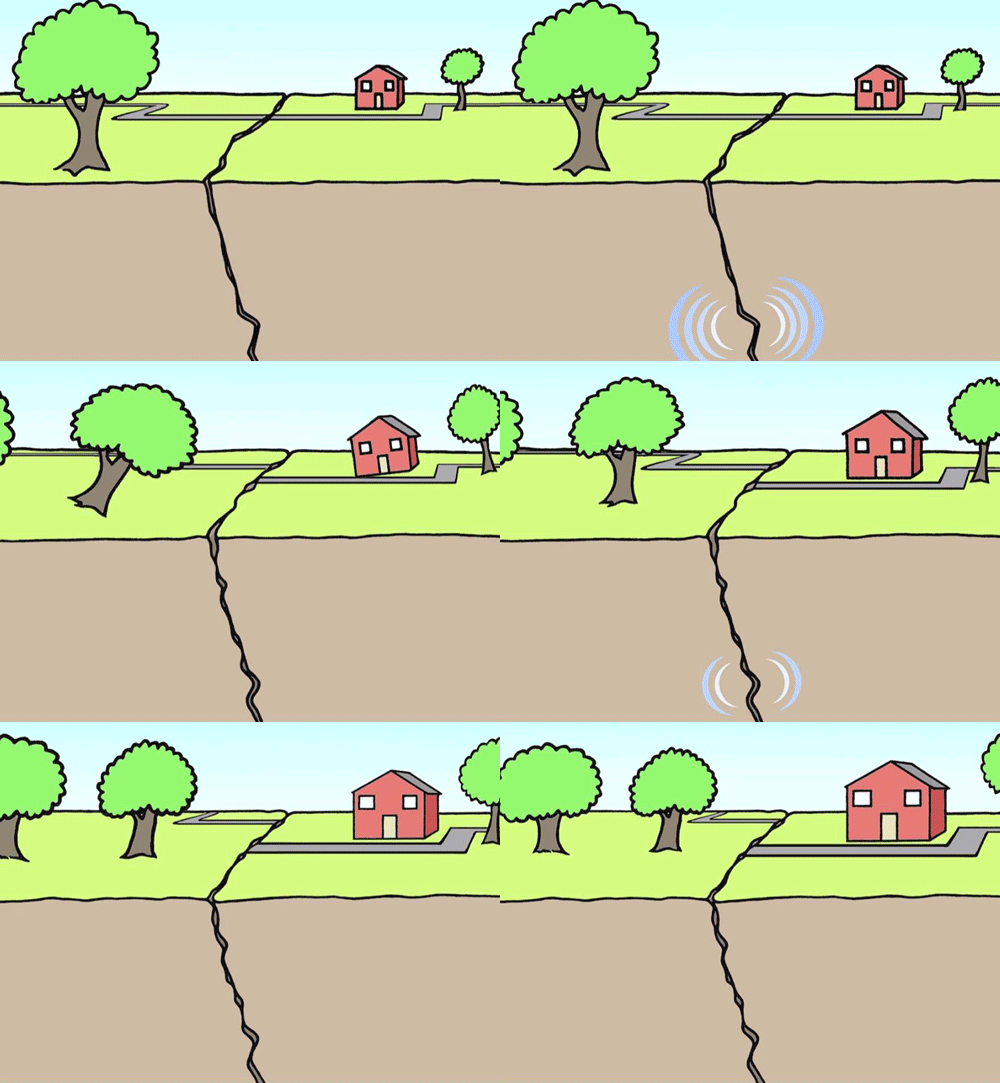
Earthquakes magnitude:
4.0 - Could shake your house as if a large truck were passing close by. Some people may not notice.
6.0 - Stuff will fall off of shelves. Walls in some houses may crack and windows break. Pretty much everyone near the center will feel this one.
7.0 - Weaker buildings will collapse and cracks will occur in bridges and on the street.
8.0 - Many buildings and bridges fall down. Large cracks in the earth.
9.0 and up - Whole cities flattened and large-scale damage.
Epicenters and Hypocenters:
The place where the earthquake starts, below the surface of the earth, is called the hypocenter. The place directly above this on the surface is called the epicenter. The earthquake will be the strongest at this point on the surface.

Can scientists predict earthquakes?
Unfortunately scientists cannot predict earthquakes. The best they can do today is point out where fault lines are so we know where earthquakes are likely to occur.
Fun Facts about Earthquakes
The largest earthquake ever recorded in the world was in Chile in 1960. It measured a 9.6 on the Richter Scale. The largest in the US was a 9.2 magnitude in Alaska in 1964. They can cause huge waves in the ocean called tsunamis. Movement of tectonic plates has formed large mountain ranges like the Himalayas and the Andes. Earthquakes can happen in any kind of weather. Alaska is the most seismically active state and has more large earthquakes than California.
SOURCE: www.ducksters.com
domingo, 26 de junio de 2016
Extreme Poverty
The World Bank estimates that 1.44 billion people live in extreme poverty and subsist on an average of US $1.25 or less a day. But extreme poverty is more than a lack of money or material resources. It is a condition whereby an individual lacks the opportunity to make meaningful choices that will sustain-ably improve his or her life. By this definition, the Multidimensional Poverty Index estimates that 1.6 billion people are living in extreme poverty.
Not only is extreme poverty a crushing and often deadly condition, but it is also a contributing factor to many of the world’s biggest problems: HIV/AIDS, child slavery, unsafe drinking water, corruption, the spread of Ebola, and 21st century terrorism and insurgency.
Not only is extreme poverty a crushing and often deadly condition, but it is also a contributing factor to many of the world’s biggest problems: HIV/AIDS, child slavery, unsafe drinking water, corruption, the spread of Ebola, and 21st century terrorism and insurgency.

Source: http://www.nuruinternational.org/why/extreme-poverty/
viernes, 24 de junio de 2016
WHAT IS AN ECOSYSTEM?
(form)
 An ecosystem includes all of the living things (plants, animals and organisms) in a given area, interacting with each other, and also with their non-living environments (weather, earth, sun, soil, climate, atmosphere).
 In an ecosystem, each organism has its' own niche or role to play.
Consider a small puddle at the back of your home. In it, you may find all sorts of living things, from microorganisms to insects and plants. These may depend on non-living things like water, sunlight, turbulence in the puddle, temperature, atmospheric pressure and even nutrients in the water for life.
What are the different types of ecosystems?
There are very many types of ecosystems out there, but the three major classes of ecosystems, sometimes referred to as ‘biomes’, which are relatively contained, are the following:
- Freshwater Ecosystems
- Terrestrial Ecosystems
- Ocean Ecosystems

Sources: http://eschooltoday.com/
http://www.conserve-energy-future.com
Suscribirse a:
Entradas (Atom)